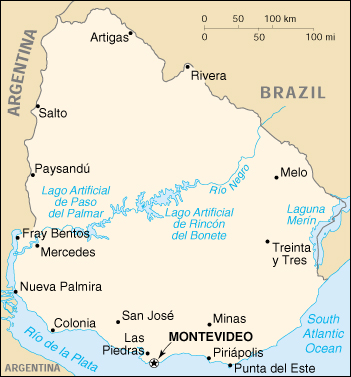
Facts About Uruguay
Background: A violent Marxist urban guerrilla movement, the Tupamaros, launched in the late 1960s, led Uruguay’s president to agree to military control of his administration in 1973. By the end of the year the rebels had been crushed, but the military continued to expand its hold throughout the government. Civilian rule was not restored until 1985. Uruguay’s political and labor conditions are among the freest on the continent.
Government type: republic
Capital: Montevideo
Currency: 1 Uruguayan peso ($Ur) = 100 centesimos
Geography of Uruguay
Location: Southern South America, bordering the South Atlantic Ocean, between Argentina and Brazil
Geographic coordinates: 33 00 S, 56 00 W
Area:
total: 176,220 sq km
land: 173,620 sq km
water: 2,600 sq km
Land boundaries:
total: 1,564 km
border countries: Argentina 579 km, Brazil 985 km
Coastline: 660 km
Maritime claims:
continental shelf: 200-m depth or to the depth of exploitation
territorial sea: 200 nm; overflight and navigation guaranteed beyond 12 nm
Climate: warm temperate; freezing temperatures almost unknown
Terrain: mostly rolling plains and low hills; fertile coastal lowland
Elevation extremes:
lowest point: Atlantic Ocean 0 m
highest point: Cerro Catedral 514 m
Natural resources: arable land, hydropower, minor minerals, fisheries
Land use:
arable land: 7%
permanent crops: 0%
permanent pastures: 77%
forests and woodland: 6%
other: 10% (1997 est.)
Irrigated land: 7,700 sq km (1997 est.)
Natural hazards: seasonally high winds (the pampero is a chilly and occasional violent wind which blows north from the Argentine pampas), droughts, floods; because of the absence of mountains, which act as weather barriers, all locations are particularly vulnerable to rapid changes in weather fronts
Environment – current issues: water pollution from meat packing/tannery industry; inadequate solid/hazardous waste disposal
Environment – international agreements:
party to: Antarctic-Environmental Protocol, Antarctic-Marine Living Resources, Antarctic Treaty, Biodiversity, Climate Change, Climate Change-Kyoto Protocol, Desertification, Endangered Species, Environmental Modification, Hazardous Wastes, Law of the Sea, Marine Life Conservation, Ozone Layer Protection, Ship Pollution, Tropical Timber 94, Wetlands
signed, but not ratified: Marine Dumping, Nuclear Test Ban
Geography – note: second-smallest South American country (after Suriname); most of the low-lying landscape (three-quarters of the country) is grassland, ideal for cattle and sheep raising.
People of Uruguay
Uruguayans share a Spanish linguistic and cultural background, even though about one-quarter of the population is of Italian origin–most are Roman Catholic. Church and state are officially separated.
Uruguay is distinguished by its high literacy rate, large urban middle class, and relatively even income distribution. The average Uruguayan standard of living compares favorably with that of most other Latin Americans. Metropolitan Montevideo, with about 1.4 million inhabitants, is the only large city. The rest of the urban population lives in about 20 towns. During the past two decades, an estimated 500,000 Uruguayans have emigrated, principally to Argentina and Brazil. As a result of the low birth rate, high life expectancy, and relatively high rate of emigration of younger people, Uruguay’s population is quite mature.
Population: 3,415,920 (July 2005 est.)
Age structure:
0-14 years: 24.39%
15-64 years: 62.61%
65 years and over: 13%
Population growth rate: 0.78%
Birth rate: 17.36 births/1,000 population
Death rate: 9.03 deaths/1,000 population
Net migration rate: -0.51 migrant(s)/1,000 population
Infant mortality rate: 14.7 deaths/1,000 live births
Life expectancy at birth:
total population: 75.44 years
male: 72.11 years
female: 78.96 years
Total fertility rate: 2.36 children born/woman
Nationality:
noun: Uruguayan(s)
adjective: Uruguayan
Ethnic groups: white 88%, mestizo 8%, black 4%, Amerindian, practically nonexistent
Religions: Roman Catholic 66% (less than one-half of the adult population attends church regularly), Protestant 2%, Jewish 1%, nonprofessing or other 31%
Languages: Spanish, Portunol, or Brazilero (Portuguese-Spanish mix on the Brazilian frontier)
Literacy:
definition: age 15 and over can read and write
total population: 97.3%
male: 96.9%
female: 97.7% (1995 est.)
History of Uruguay
URUGUAY USED TO BE KNOWN as the “Switzerland of South America,” but clearly not because of any geographical similarity. Although it is the second smallest country in South America (after Suriname), Uruguay is more than four times larger than landlocked Switzerland, and its highest peak is only 501 meters. Rather, the analogy was made because Uruguay enjoyed other Swiss-like attributes. It was a peaceful, conservative country with a bountiful, livestock-based economy. It was also home to South America’s first social democracy; a cradle-to-grave welfare system; and a largely urban, homogeneous, and relatively well- educated population. A political slogan of the 1940s proudly boasted, “There’s no place like Uruguay.”
Beginning with the prolonged stagnation of their country’s industrial and livestock sectors in the mid-1950s, however, Uruguayans began losing their economic well-being, civility, and tranquillity. By the late 1960s, Uruguay was suffering from high inflation and public deficits and was governed by an authoritarian president, instead of by the former revolving collegial executive (colegiado) that had been modeled on the Swiss system and designed to avoid a concentration of power. In 1973 Uruguayans also lost their cherished freedom and their democratic system when the country was plunged into one of Latin America’s most repressive military dictatorships (1973-85). The country’s democratic system was not fully restored until 1990.
Having fallen far behind many countries economically, Uruguayans could only reminisce about their former welfare state. In a discussion of Uruguay’s global ranking, the late political scientist and Uruguay specialist Charles Guy Gillespie noted that “Uruguayan society in 1990 presented a rather contradictory picture of advanced social indicators and declining economic status.” Since Gillespie’s research was completed, Uruguay has risen to be the highest ranking country in South America and Central America on the United Nations Development Programme’s 1991 Human Development Index (HDI), a measure that combines per capita gross domestic product with such factors as longevity and access to education. In world HDI ranking, however, Uruguay slipped from twenty-ninth place in 1990 to thirty-first place in the 1991 report.
The assumption of the presidency by Luis Alberto Lacalle de Herrera in 1990 improved the country’s political development index by marking the success of Uruguay’s five-year transition back to democracy. Undeterred by their nation’s serious economic problems, tens of thousands of the Uruguayans who had fled the country during the military regime returned home. Instead of the old Uruguay, however, they found their traditionally statist society undergoing privatization and sharp cutbacks in social services under the Lacalle government’s plan to turn the nation into a South American “Singapore.”
Yet, unlike the Swiss, for whom modernization and traditionalism were mutually compatible, Uruguayans in general were stubbornly resistant to Lacalle’s vision of a free-market economy, which had been much talked about during the previous administration of Julio María Sanguinetti Cairolo (1985-90), and to changing their old ways, which still included horse-and-buggy milk deliveries in Montevideo. This predilection for traditionalism over modernism was explained in part by the fact that Uruguay, a country with a low birth rate and long life expectancy, had Latin America’s oldest population. With a work force of 1.4 million in 1990, Uruguay had 650,000 people receiving pensions. Another explanation was a general uncertainty as to whether modernization offered a better future. As Jorge Batlle Ibáñez, a 1989 presidential candidate, explained in the weekly news magazine Búsqueda:
Uruguay is the most difficult country in Latin America to change because, being the smallest [sic] country, it lacks masses that could switch rapidly or violently from one side to the other, and it has a relatively prosperous middle class that feels there are few opportunities for easily finding another destiny without losing what they already have.
Nevertheless, the new destiny as a regional free-trade and financial center envisioned for the nation by Lacalle seemed designed to make better use of the country’s existing geographic and economic advantages, as well as its historical role as gatekeeper to the Río de la Plata Basin trade region.
Although not a maritime nation, Uruguay is surrounded on three sides by water. Three rivers (the Río de la Plata, one of the widest rivers in the world; the Río Uruguay; and the Río Yaguarón), a lake (Laguna Merín), and the Atlantic Ocean border the country. The main port and capital city of Montevideo, founded in 1726, is situated on strategic trade routes.
Even the name of Uruguay, first applied to the Río Uruguay, has river-related origins. Its etymology derives from either uruguä, a Guaraní Indian word meaning a species of mussel, thus Río Uruguay, “the river of shellfish”; or the Guaraní word components uru (a kind of bird that lived near the river); gua (“to proceed from”); and y (“water”).
Uruguay also has long been associated with cattle and sheep and the gauchos who have herded them, as well as with verdant grasslands. The country’s traditional beef and wool exports have been well known in world markets. A land of gentle hills and rolling plateau covered by tall prairie grass, Uruguay has been often referred to in travel books as “the purple land” since the publication in 1885 of a book by British naturalist and travel writer W.H. Hudson. In addition to the purple verbena wildflowers (margaritas) that populate the grasslands from December through March, the red sandstone in the northern area has a faint purplish hue.
When discovered by Spanish conquistador Juan Díaz de Solís in 1516, the Río de la Plata region was inhabited only by fierce Charrúa and Guaraní Indians and an enormous wildlife population, including ostrich-like birds called rheas. The region disappointed Spaniards in search of gold and silver riches. As a consequence, the first Spanish settlement, in Soriano at the mouth of the Río Negro in the southwest, was not established until 1624, after the gold fever had cooled. Unlike elsewhere in Latin America, the native population, which remained hostile to settlers, was left relatively undisturbed, at least until the beginning of the seventeenth century.
Jesuit and Franciscan missionaries proselytized among the Indians, but with limited success. Most of the Indians in fact remained hostile and eventually perished in battles with Spanish and Portuguese forces (but not, as in other places in the Americas, in working the land or mines as serfs). Because the native population was relatively small and so few Indians survived (the last Charrúa Indian died in 1948), present-day Uruguay, unlike most Latin American countries, has only an 8 percent mestizo presence.
With the separation of their thrones in the mid-seventeenth century after sixty years of joint rule, Spain and Portugal began an intense rivalry for control of the Río de la Plata region, mainly because of its strategic trade location. From 1680, when the Portuguese established their first settlement at Colonia del Sacramento, to 1827, the forces of Spain and Portugal fought over the region known as the Banda Oriental (eastern side, or bank), the fertile plain east of the Río Uruguay that would later become known as Uruguay.
Much of Uruguay’s nineteenth-century history featured an endless succession of invasions, coups, dictatorships, and civil wars. However, the half-year-long occupation of Montevideo by British forces in 1807, followed by an invasion of British merchants, left the city with an enduring cultural legacy. It included the country’s first printing press and an English/Spanish weekly newspaper, The Southern Star/La Estrella del Sur, which introduced Montevideans to British democracy and strengthened a desire among them for self-government and independence from Spain. Accordingly, their resentment of being subordinate to the viceroyalty capital of Buenos Aires grew.
The nine-year campaign (1811-20) by José Gervasio Artigas to take control of Montevideo successively from the Spanish, the Argentines, and the Portuguese engendered a new sense of nationality among the residents of the Banda Oriental. The announcement by the Portuguese in 1821 that Brazil was annexing the Banda Oriental and renaming it the Cisplatine Province prompted Juan Antonio Lavalleja to launch a guerrilla war against Brazilian forces. Lavalleja and his fellow revolutionaries (later called the Thirty-Three Heroes), assisted by Argentine troops, sparked a countrywide insurgency that escalated into a war between Argentina and Brazil (1825-28). Aided by Britain’s mediation, both Argentina and Brazil renounced their claims to the Banda Oriental, at least in theory, and the Oriental Republic of Uruguay (República Oriental del Uruguay) became officially independent on August 27, 1828. Uruguay was the last nation in South America to be created from the Spanish colonies.
The new nation’s first constitution, a liberal document, was adopted on July 18, 1830, and would remain unchanged for eighty- seven years. Shortly after its adoption, Uruguay’s two main political parties–the Colorado Party (Partido Colorado) and the National Party (Partido Nacional, usually referred to as the Blancos)–emerged from armed clashes. The Colorado Party was composed of Montevideo-based middle-class liberals, whereas the National Party was made up of rural-based conservative landowners and merchants. Their mutual hostility erupted into the Great War (Guerra Grande, 1843-52), in which Colorado-held Montevideo was once again besieged in another nine-year war, this time involving Uruguayan, Argentine, Brazilian, French, British, and Italian forces (including Italian patriot Giuseppe Garibaldi). Following the war, which was economically disastrous for Uruguay, a policy of fusion (fusión), in which the Colorado and National parties agreed to cooperate, created the political framework and stability that were conducive to economic recovery and growth.
The fusion policy was cast aside with the onset of the War of the Triple Alliance (1865-70), in which Colorado-ruled Uruguay was, ironically, an ally of Argentina and Brazil against hopelessly outmatched Paraguay. The war ended armed foreign intervention in Uruguayan affairs, but fighting between the gaucho forces of the ruling Colorados and the opposition Blancos resumed. In 1872, however, the two parties reached an accord under which the National Party was given control of four of the country’s departments, but the Colorado Party remained in power. This new policy of coparticipation (coparticipación) represented a compromise between the two parties and was a policy that would continue in Uruguayan politics. A political watershed in Uruguay’s struggle for stability was another interparty accord reached in 1897, following a civil war, under which all citizens were guaranteed political rights and the National Party increased the number of departments under its control to six.
In the last quarter of the nineteenth century, heavy immigration from Europe, either directly or by way of Argentina or Brazil, propelled social and political changes, and Uruguay made progress toward becoming a more stable and peaceful state. By 1872 one- fourth of the population was foreign born and by 1900, one-third. The European immigration produced an urban and secular society that was largely middle class, with European values. The northern European immigrants tended to be of middle-class origin, whereas the predominant Spaniards and Italians were more often of working-class origin.
Uruguay adopted free, compulsory, and secular education in 1876, thanks to the efforts of educator José Pedro Varela (president, 1875-76), who was influenced by Horace Mann of the United States. Varela lived only thirty-five years, but his basic principles of education, which were incorporated into the 1877 Law of Common Education, have endured, allowing Uruguay to become one of the most literate of Latin American nations.
The foundations of the modern state and of the governmental institutions and political traditions were laid in the first two decades of the twentieth century, but particularly during the second presidential term of the Colorado Party’s José Batlle y Ordóñez (1903-07, 1911-15). Under Batlle y Ordóñez’s influence, Uruguay implemented even more profound social reforms–becoming Latin America’s first country to adopt a minimum wage scale for its agricultural workers, obligatory voting, and women’s suffrage–and became a stable social democracy modeled on the Swiss system, which Batlle y Ordóñez had studied in Switzerland between terms. Batlle y Ordóñez also instituted a Swiss-style presidency designed to prevent dictatorships. Under it, the nine members of the National Council of Administration (Consejo Nacional de Administración), or collegial executive (colegiado), rotated the presidency for one-year terms. Batlle y Ordóñez’s new executive system and social reforms were adopted in the 1917 constitution.
With revenue generated from their country’s vast wool and beef exports, Uruguayans enjoyed Latin America’s highest standard of living, which included free public education through the university level, expanded public-sector employment, and a generous social welfare system that permitted people (with the exception of the rural poor) to retire in middle age. Uruguay was so prosperous that in 1920 it forgave France a US$100 million debt.
The “welfare state” system limited the appeal of revolutionary ideologies and parties by co-opting their programs, minimizing social and economic stratification, and giving the majority of the population a stake in the existing order. These and other factors, such as racial and ethnic homogeneity and the high level of mobility within the predominantly middle-class social structure, all contributed to the relative stability of the country’s democratic system. Uruguay ranked with Chile and Costa Rica as one of the most stable democracies in Latin America, although it, like most countries, suffered from the Great Depression. Uruguay was subjected to dictatorial rule only once during the first half of the twentieth century (1933-38). Even then, the ad hoc regime was headed by a civilian, Gabriel Terra, who had been elected president, at least initially. Moreover, Terra preserved the country’s social reforms.
Uruguay enjoyed a boom in wool and meat exports during World War II and the Korean War. Unlike Argentina, it sided with the Allies during World War II and hosted United States air and naval bases. Economic stagnation and decline, however, followed the post- Korean War drop in world demand for livestock products. Pressures created by those developments–combined with growing political lethargy, sectarianism, and governmental inefficiency and corruption–unraveled the nation’s delicate social fabric and precipitated rising levels of class conflict. In the second half of the 1960s, Uruguay was racked by continual labor militancy and urban terrorism by the National Liberation Movement-Tupamaros (Movimiento de Liberación Nacional-Tupamaros–MLN-T) that propelled the military increasingly into the political arena.
Jorge Pacheco Areco (1967-72) and Juan María Bordaberry Arocena (1972-76), both members of the Colorado Party, governed under increasingly frequent states of siege and allowed the military to pursue its national security goals without regard for constitutional safeguards or laws. Put in charge of fighting the Tupamaros in late 1971, the armed forces defeated the urban guerrillas within six months. Nevertheless, repression continued, and the military assumed a greater political role, in effect making Bordaberry little more than a figurehead president. Opposing these Colorado Party regimes were the National Party and the newly formed Broad Front (Frente Amplio), a coalition of disaffected Colorados, socialists, communists, and other left-of- center parties.
When the General Assembly (the legislature) resisted final approval of draconian national security measures imposed by the military, Bordaberry abolished the General Assembly on June 27, 1973, thereby commencing the dictatorship. The regime prohibited all political party activity, suppressed the opposition press, disbanded the National Convention of Workers (Convención Nacional de Trabajadores–CNT) as well as all parties in the Broad Front, arrested left-of-center political and union leaders, and prohibited all labor union activities. In June 1976, after forcing Bordaberry to resign, the military assumed total control of the country.
According to Amnesty International, a private human rights organization, under the military regime Uruguay had the world’s highest per capita ratio of political prisoners: one in every 500 citizens. By 1980 many citizens had been detained and tortured at some point, and one in every 500 had received a sentence of six years or longer. Between 300,000 and 400,000 Uruguayans went into exile.
Fortunately for Uruguayan democracy, the military’s attempt to institutionalize its rule by submitting its proposed constitutional reform to a national referendum in November 1980 backfired. By a vote of 57 percent to 43 percent, Uruguayans rejected the proposed national security state. As a result, Lieutenant General (retired) Gregorio Alvarez Armelino (1981-85) was obliged to transfer power to an elected civilian, Julio María Sanguinetti.
During the first half of the Sanguinetti administration, Uruguay became an atypical island of economic stability and, thanks to a deregulated financial system, a refuge for capital fleeing Argentina and Brazil. Although Uruguay bore a heavy foreign debt load, it never stopped paying on its debt. Uruguay also had important gold reserves, one of the largest in proportion to its indebtedness and economic potential. During the final two years of Sanguinetti’s administration, however, the economy suffered a downturn. In 1989 inflation had increased to 85 percent, the foreign debt to US$6.7 billion, and the fiscal deficit to 8.5 percent of GDP, and the purchasing power of salaries had fallen.
During Sanguinetti’s administration, Uruguay, like other Latin American countries undergoing a transition from military dictatorship to democracy, found itself confronted with the dilemma of having to decide between prosecuting military officers for crimes committed during the period of military rule, and thereby risk antagonizing civil-military relations, or granting them a blanket amnesty. Sanguinetti had noted that every conflict in Uruguayan history was followed by a generous amnesty law. Nevertheless, a 1986 law granting amnesty to the military was so controversial that a national referendum on the issue had to be held. In a 1989 referendum, a majority of the population upheld the law exempting military officers from human rights prosecutions.
Thus, Lacalle was spared from having to contend with the amnesty issue after assuming office as Uruguay’s president. Yet, he quickly caused grumbling within the armed forces by asserting his presidential prerogative and naming two trusted officers to head the navy and air force, thereby sidestepping the order of military seniority. The military was already unhappy with its shrinking size and the reduction in the military budget during the Sanguinetti administration.
Although the military reaffirmed its subservience to the nation’s democracy, Lacalle ordered the Ministry of National Defense in May 1990 to formulate a new armed forces doctrine “within the framework of the Constitution and current laws.” The guidelines were to restrict its scope of action by excluding the military from responding to ordinary internal conflicts that came within the sphere of the police. Nevertheless, Army Commander Lieutenant General Guillermo de Nava raised concerns among Uruguayan politicians because of his public endorsement of a retired general’s statements in April 1991 warning of a comeback by the Tupamaros and the Communist Party of Uruguay and calling for Uruguayan society to be placed on a “red alert.”
Lacalle also embarked on an austere economic adjustment program that had two main components: a reduction in public spending and the inflation rate, as well as an increase in certain taxes. He succeeded in his first year in office in cutting spending by 10 percent and increasing revenue by 9 percent. Nevertheless, real wages in the public sector fell by 9 percent and in the private sector, by 6 percent; GDP growth in 1990 was negligible; and inflation reached 129 percent by year’s end.
The popularity of the Blancos plummeted from about 38 percent at the time of the 1989 election to 21 percent in December 1990, according to a public opinion poll published by Búsqueda. Lacalle at least shared company with the Marxist mayor of Montevideo, the Broad Front’s Tabaré Vásquez, whose popularity fell from 35 to 30 percent; national support for the Broad Front slipped from 26 to 24 percent. Essentially, in the wake of the 1989 elections the two traditional parties no longer dominated Uruguay, and Montevideo in particular. (Vásquez even assumed a diplomatic role by paying a five-day visit to Cuba in June 1991 and signing a five-year agreement of intent for bilateral cooperation with Havana.)
Lacking a parliamentary majority, Lacalle formed a governing coalition, National Coincidence (Coincidencia Nacional), with the Colorados but encountered strong resistance to his proposed austerity and privatization programs. Labor union opposition to these plans and support of wage claims increased during 1991, taking the form of work stoppages, slowdowns, and, in May, a one- day general strike (the third since Lacalle took office). Instead of using the unpopular term privatization to describe his economic policy agenda, Lacalle called instead for a redefinition of the role of the state, deregulation, and elimination of monopolies.
In the first of a number of proposed privatizations (which included the telephone company, the state airline, and state monopolies on insurance, port services, and production of alcohol), the government sold the state-owned Commercial Bank (Banco Commercial) in July 1990 to a group of international investors. They and other multinational investors regarded Uruguay as an increasingly important regional financial market because of its liberal foreign investment exchange and banking regulations, strategic location, stable political climate, and relatively predictable economic policies.
Like Switzerland, Uruguay in 1990 continued to serve as an international meeting place and a banking center. Uruguay has long been known as a location for international economic conferences. The eleven-member Latin American Integration Association has been headquartered in Montevideo since its inception in 1980. For many of the West’s economists, in the early 1990s the word Uruguay was synonymous with the Uruguay Round of negotiations of the General Agreement on Tariffs and Trade. International meetings often have been held in Punta del Este, a popular resort city.
Aided by its bank secrecy laws first implemented by the military regime in the early 1980s, Uruguay built up its offshore banking system beginning in 1989. A negative outgrowth of this was the nation’s growing reputation as a center for money laundering; such activity increased dramatically in Uruguay after Colombian drug traffickers abandoned Panama following the United States military intervention in December 1989. According to a document issued by the United States Department of State in April 1991, Uruguay continued to be a “significant” center for money laundering because of its free-trade system, the large number of currency exchange houses (more than seventy in Montevideo), and the absence of government regulation of the operation and movement of funds. In May 1991, Uruguay and the United States signed an agreement, which was similar to one signed between Switzerland and the United States in 1991, to facilitate joint action against money laundering operations by drug smugglers. The accord had not yet gone into effect as of mid-July 1991, pending ratification by the legislatures of both countries.
Most Uruguayans were more concerned with their own bank accounts than with those of foreign drug traffickers. Lacalle did not improve his standing in the popularity polls by introducing “unpleasant” economic measures in his speech on his first anniversary in office. He also warned the General Assembly that unless it reformed the social security system by curbing its generous benefits (already cut by 17.4 percent in 1990), his savings in controlling public expenditures would be lost. Although Uruguay supported the world embargo against Iraq, its effects were, in Lacalle’s words, “particularly painful” for Uruguay because of lost mutton exports to Iraq and higher oil import costs.
On March 26, 1991, Uruguay sought to revive its export sector by signing, along with Argentina, Brazil, and Paraguay, the Treaty of Asunción, a pact that created the Southern Cone Common Market (Mercado Común del Sur–Mercosur). Mercosur, which was scheduled to go into effect on January 1, 1995 (a member, however, could decide to drop out before then), was the goal of various regional integration agreements, such as the River Transport System, consisting of the Río Paraguay-Río Paraná-Río Uruguay waterway.
Mercosur was formed in part in response to President George H.W. Bush’s June 1990 Enterprise for the Americas Initiative. The Mercosur nations and the United States signed a letter of intent on June 19, 1991, that could eventually lead to a free-trade pact modeled on the Mexico-United States accord. However, serious obstacles to a free-trade pact between the United States and the Mercosur nations remained, such as a collective US$200 billion foreign debt and persistent regional trade barriers.
Although Uruguay’s Senate ratified the country’s participation in Mercosur, the nation’s initial enthusiasm soon waned. Uruguayan business and agricultural organizations were concerned that neighboring giants, particularly Brazil, would only take advantage of lower Uruguayan tariffs to increase competition. In an interview with the Buenos Aires daily El Clarín in late June 1991, Lacalle said, somewhat optimistically, that Uruguayan businessmen were viewing Mercosur not with resistance but with feelings of “caution, a reasonable expectation, a desire for a smooth transition period.”
Of course, the emergence of Mercosur and the prospect of a free- trade agreement with the United States were anathema to the Uruguayan left. The Broad Front also feared proposed military cooperation within Mercosur, arguing that Uruguay could become a pawn of Argentina and Brazil. In any event, Montevideo, in its growing capacity as a regional financial and banking services center and potential hub of free trade–despite its Marxist mayor–seemed in July 1991 to be moving closer, if reluctantly, to becoming what Lacalle envisioned as the “gateway” to Mercosur.
July 16, 1991
* * *
In May 1992, Mercosur continued to be President Lacalle’s main instrument for ensuring that competition came to his country. Aided by events in Eastern Europe, Lacalle’s tariff-free trading vision of Uruguay’s future found greater receptivity among Uruguayans to free-market reforms and smaller government. Nevertheless, resistance to the Lacalle government’s attempts to restructure the state sector remained substantial. Uruguayan businessmen worried that Argentine and Brazilian industries would devour them. According to a poll taken in February 1992, about 54 percent of the Uruguayans who were queried opposed the privatization policy.
With only thirty-nine seats in the Chamber of Representatives, the Lacalle government was forced to negotiate support for each of its initiatives with the Colorado Party (thirty seats), Broad Front (twenty-one seats), and New Sector (Nuevo Espacio; nine seats). Consequently, it was not until September 1991, by which time Lacalle’s popularity had fallen to 11 percent, that the General Assembly narrowly approved his privatization law (the Public Companies Law), after eighteen months of drafting it and four months of debating it. This law allowed private entrepreneurs to compete in a bidding system for the right to privatize public services.
Reflecting growing opposition to his economic policy of austerity and privatization, Lacalle’s National Coincidence alliance and his narrow parliamentary majority collapsed by early 1992. At the end of January 1992, Lacalle had to call for the resignation of his cabinet ministers, who were then “provisionally ratified.” By that April, dissent had emerged even within the ruling National Party, with two factions opposing the strong tightening of workers’ salaries, which had particularly affected state workers. One of these factions, calling itself the Progressive Pole (Polo Progresista) and supported by several prominent Blancos, including Senator Alberto Sáenz de Zumarán, launched itself as a new party on May 10.
Opposition to Lacalle’s new law focused on the major privatizations planned for Uruguayan National Airlines (Primeras Líneas Uruguayas de Navegación Aérea–PLUNA), the National Administration for the Generation and Transmission of Electricity (Administración Nacional de Usinas y Transmisiones Eléctricas– UTE), and the National Administration of Fuels, Alcohol, and Portland Cement (Administración Nacional de Combustibles, Alcohol, y Portland–ANCAP). So-called peripheral divestments included the National Printing Press (Imprensa Nacional), hospital services, administration of air terminals and three port terminals, and agricultural development facilities. Confrontations were imminent within these and other state enterprises, which operated as autonomous entities run by five-man executive boards in which three were progovernment party members and two were opposition party members. The opposition Colorado Party members were expected to ally themselves with the National Party members opposed to the government’s economic policy.
The government’s salary measure, which prompted the sixth general strike against the government, was implemented as a result of an agreement with the International Monetary Fund to unfreeze some US$300 million in credits to be used for repaying the US$7.4 billion foreign debt, which grew by US$405 million in the Lacalle administration’s first two years.
In a few other areas, Uruguay made some good economic progress in 1991. Buoyed by 850,000 tourists in 1991 plus internal demand (both consumption and investment), the country enjoyed robust growth during the year. Inflation was at least 90 percent, as compared with 129 percent in 1990.
However, other economic and social problems worsened. In addition to the increase in trade union conflicts, unemployment rose from 8.4 percent in January 1991 to 9.2 percent at the end of 1991, and GDP grew by at best 0.5 percent in 1991, as compared with 0.9 percent in 1990. Moreover, according to a report by the General Directorate of Statistics and Census based on a household survey, 15.8 percent of all Uruguayan families were living in a state of “critical poverty” in 1991 (as compared with 11 percent in 1981), while 22.3 percent lacked one or more basic needs, such as housing, water supply, sanitation, education, or a living wage.
Meanwhile, middle-class Uruguayans and the political system were resisting Lacalle’s proposals to restructure the old welfare system, such as a proposal to raise the qualifying age for retirement pensions–fifty-five years of age for women and sixty for men–by five years. In his speech to the nation on May 26, 1992, Lacalle pointed out that the country’s social security bill had risen from US$718 million in 1985 to US$1.1 billion in 1991, creating an ever-widening deficit.
Ironically, the country was enjoying a bout of euphoria over the startling discovery of a gold-laden Spanish galleon, El Preciado, that sank eight kilometers from the Montevideo harbor in June 1792. Many Uruguayans, including some politicians and government officials, anticipated a windfall that could be used for social services from the treasure and from as many as seven other sunken ships known to be in the area with large amounts of gold. Based on the amount of gold already recovered, the El Preciado booty was estimated to be worth from US$300 million to US$3 billion.
In contrast to the plunging popularity of Lacalle and his National Party, the popularity rating of Montevideo’s leftist mayor, Tabaré Vázquez, soared to 53 percent in September 1991, increasing the Broad Front’s confidence of victory in the 1994 elections. By November 1991, the Broad Front’s popularity had risen to 24 percent, making it the second most popular party after the Colorado Party, which had a 41 percent popularity rating (the National Party was supported by only 19 percent of those surveyed in an April 1992 poll). Taking a cue from events in the former Soviet Union, the Broad Front officially abandoned its commitment to Marxist-Leninist principles.
In April 1992, however, the Broad Front’s most radical member, the Uruguayan Revolutionary Movement (Movimiento Revolucionario Oriental–MRO), stepped back into an earlier, dark era by endorsing “an armed struggle strategy.” That approach was also adopted by a self-styled right-wing paramilitary group linked to military officers and called the Juan Antonio Lavalleja Command (Comando Juan Antonio Lavalleja), which launched a series of bombings, including one against Sanguinetti’s office, and bomb threats in May. The resulting climate of fear and restlessness, which had characterized the early 1970s, seemed anachronistic in the Uruguay of the 1990s, where democracy supposedly had been consolidated. The military-linked terrorism and the public remarks made by some retired military officers revealing sentiment in favor of a coup also seemed to reflect growing military uneasiness over the prospects of a Broad Front electoral victory in 1994.
Uruguay Economy
Uruguay’s economy remains dependent on agriculture. Although agricultural production accounts for 6% of the gross domestic product (GDP), agricultural-related products make up more than half of the country’s exports. The industrial sector, which produces 17% of GDP, is largely based on the transformation of agricultural products. Leading industrial sectors include meat processing, agribusiness, leather production, textiles, leather footwear, handbags, and leather apparel.
The government’s strategy to stimulate growth and meet its debt service obligations is based on exports. Much of Uruguay’s trade is with its fellow MERCOSUR members. Uruguay is committed to an open financial system and maintains an exchange rate that floats inside a 12%-wide band; the government intervenes in the exchange market to maintain a peso/dollar devaluation rate of about 2.4% per month.
Recent governments have carried out a cautious program of economic liberalization similar to that of many other Latin American countries. The program has included lowering tariffs, eliminating deficit spending, controlling inflation–reduced from 129% in 1990 to around 3.6% in 2001–and reducing the size of the once-bloated and inefficient government. The Lacalle government implemented a 1991 state reform law, though such efforts were partially stalled when voters rejected the sale of the state telephone company, ANTEL, in a 1992 referendum. The Government of Uruguay intends to foster economic efficiency through demonopolization and cutting red tape. A budget law approved on February 2001 provides for demonopolization of telecommunications, but basic telephony remains a monopoly. It also creates the framework for regulatory offices for telecommunications and electricity, and levels the tax treatment of public and private firms.
In 2001, the government demonopolized oil refining but oil imports will remain a monopoly until 2006. Previous administrations have given the private sector access to areas formerly reserved for the state such as insurance (except for worker’s compensation), mortgages, road construction and repair, piped-gas distribution, water sanitation and distribution, cellular telephony and airline transportation. A law on energy sector reform that allows for the private generation of energy was approved in 1997. Transmission and distribution rights (wheeling rights) remain a state monopoly. According to a 2001 study by a well-known think tank, utility demonopolization would create 45,000 new jobs. Lukewarm public support for these policies, the Uruguayan public’s traditional caution, and the fragmented political system suggest that such reform efforts will continue at a slow pace.GDP: purchasing power parity – $28 billion (1999 est.), $31 billion (2000 est.)
GDP – real growth rate: -2.5% (1999 est.), -1.1% (2000 est.)
GDP – per capita: purchasing power parity – $8,500 (1999 est.), $9,300 (2000 est.)
GDP – composition by sector:
agriculture: 10%
industry: 28%
services: 62% (1999)
Inflation rate (consumer prices): 4% (1999 est.), 4.8% (2000 est.)
Labor force: 1.38 million (1997 est.), 1.5 million (1999 est.)
Unemployment rate: 12% (1999), 14% (2000 est.)
Budget:
revenues: $4 billion
expenditures: $4.6 billion, including capital expenditures of $500 million (2000 est.)
Industries: food processing, electrical machinery, transportation equipment, petroleum products, textiles, chemicals, beverages
Industrial production growth rate: -4% (1999 est.), -2.1% (2000 est.)
Electricity – production: 5.704 billion kWh (1999)
Electricity – production by source:
fossil fuel: 3.86%
hydro: 95.44%
nuclear: 0%
other: 0.7% (1999)
Electricity – consumption: 5.89 billion kWh (1999)
Electricity – exports: 215 million kWh (1999)
Electricity – imports: 800 million kWh (1999)
Agriculture – products: wheat, rice, barley, corn, sorghum; livestock; fish
Exports: $2.6 billion (f.o.b., 2000 est.)
Exports – commodities: meat, rice, leather products, vehicles, dairy products, wool, electricity
Exports – partners: Mercosur partners 45%, EU 20%, US 7% (1999 est.)
Imports: $3.4 billion (f.o.b., 2000 est.)
Imports – commodities: road vehicles, electrical machinery, metal manufactures, heavy industrial machinery, crude petroleum
Imports – partners: MERCOSUR partners 43%, EU 20%, US 11% (1999 est.)
Debt – external: $8 billion (2000 est.)
Currency: Uruguayan peso (UYU)
Map of Uruguay